Daemonologie
In Forme of a Dialogie
Diuided into three Bookes.
By James RX
Printed by Robert Walde-graue,
Printer to the Kings Majestie. An. 1597.
Cum Privilegio Regio.
Showing posts with label Demonology. Show all posts
Showing posts with label Demonology. Show all posts
Demogorgon Part I - Demonology Profile
Demogorgon, although often ascribed to Greek mythology, is actually attributed to a fourth-century scholar, imagined as the name of a pagan god or demon, associated with the underworld and envisaged as a powerful primordial being, whose very name had been taboo.
Etymology
The origins of the name Demogorgon are uncertain, partly because the name itself was perhaps of imaginary coinage. Various theories suggest that the name is derived from the Greek words δαίμων daimon ('spirit' given the Christian connotations of 'demon' in the early Middle Ages)—or, less likely δῆμος demos ('people')— and Γοργών Gorgon ('grim') or γοργός gorgos ('terrible'). Another, less accepted theory claims that it is derived from a variation of 'demiurge', although the two scholarly editions of the earliest mention of the term (Jahnke 1898 and Sweeney 1997) see Demogorgon as a corruption of demiurge.[1]
Derivation and history
Demogorgon is first mentioned in the commentary on Statius's Thebaid[2] often attributed in manuscripts to Lactantius Placidus. The commentary, which was composed ca. 350-400 AD, is the most common medieval commentary on the poem and is transmitted in most early editions up to 1600.[3] The commentary has been misattributed to the Christian author Lucius Caelius Firmianus Lactantius, even though the commentator appears to have been Mithraic.[4]
The name Demogorgon is introduced in a discussion of Thebaid 4.516, which mentions 'the supreme being of the threefold world' (triplicis mundi summum); in a mystical passage that seems to show Jewish influence, as it mentions Moses and Isaiah); the author says of Statius, Dicit deum Demogorgona summum ('He is speaking of the Demogorgon, the supreme god', or perhaps 'He is speaking of a god, the supreme Demogorgon'). Prior to Lactantius, there is no mention of the supposed "Demogorgon" anywhere by any writer, pagan or Christian.
In the Early Middle Ages, Demogorgon is mentioned in the tenth-century Adnotationes super Lucanum, a series of short notes to Lucan's Pharsalia that are included in the Commenta Bernensia, the "Berne Scholia on Lucan".[5] By the late Middle Ages, the reality of a primordial "Demogorgon" was so well fixed in the European imagination that "Demogorgon's son Pan" became a bizarre variant reading for "Hermes' son Pan" in one manuscript tradition of Boccaccio's Genealogia Deorum gentilium ("Genealogies of the Gods":1.3-4 and 2.1), misreading a line in Ovid's Metamorphoses.[citation needed]
After Boccaccio Demogorgon is mentioned as a "primal" god in quite a few Renaissance texts, and impressively glossed "Demon-Gorgon," i.e., "Terror-Demon" or "God of the Earth." The French historian and mythographer Jean Seznec, for instance, now spots in Demogorgon an allusion to the Demiurge ("Craftsman" or "Maker") of Plato's Timaeus. For a remarkable early text actually identifying Ovid's Demiurge (1/1, here) as "sovereign Demogorgon," see the paraphrase of Metamorphoses I in Abraham France, The third part of the Countesse of Pembrokes Yuychurch (London, 1592), sig. A2v."[6]
In literature
Demogorgon was taken up by Christian writers as a demon of Hell:
"Orcus and Ades, and the dreaded name
Of Demogorgon."
— John Milton, Paradise Lost II. 966.
Note, however, Milton does not refer to the inhabitants of Hell itself, but of an unformed region where Chaos rules with Night. In Milton's epic poem Satan passes through this region while traveling from Hell to Earth.
Demogorgon's name was earlier invoked by Faustus in Scene III of Christopher Marlowe's Doctor Faustus (1590) when the eponymous Doctor summons Mephistopheles with a Latin incantation.
The 16th century Dutch demonologist Johann Weyer described him as the master of fate in hell's hierarchy.[7]
According to Ariosto's Orlando Furioso, Demogorgon has a splendid temple palace in the Himalaya mountains where every five years the fates and genii are all summoned to appear before him and give an account of their actions. They travel through the air in various strange conveyances, and it is no easy matter to distinguish between their convention and a Witches' Sabbath. When elements of Ariosto's poem supplied Philippe Quinault's libretto for Jean-Baptiste Lully's opera Roland, performed at Versailles, 8 January 1685, Demogorgon was king of the fairies and master of ceremonies. Demorgogon is also mentioned in the Book II of the epic poema El Bernardo written in Mexico by Bernardo de Balbuenain the 17th. century and published in Spain 1624. The passage tells how the fairy Alcina visits Demorgogon in his infernal palace.
Aquí Demogorgon está sentado
en su banco fatal, cuyo decreto
de las supremas causas es guardado
por inviolable y celestial preceto.
Las parcas y su estambre delicado
a cuyo huso el mundo está sujeto,
la fea muerte y el vivir lúcido
y el negro lago del oscuro olvido
(Libro II, estrofa 19)
Edmund Spenser mentioned him briefly in The Faerie Queene:
A bold bad man, that dar'd to call by name
Great Gorgon, Prince of darknesse and dead night,
At which Cocytus quakes, and Styx is put to flight. (Canto I, stanza 37)
He is also the protagonist of an opera Il Demogorgone, ovvero il filosofo confuso ("Demogorgon, or the Confused Philosopher" by Vincenzo Righini (1786) with a libretto by Lorenzo da Ponte, which was originally written for Mozart.[8]
In Moby-Dick, Starbuck describes the white whale as Ahab's demogorgon.
Demogorgon is also a character in Percy Bysshe Shelley's Prometheus Unbound. In this lyrical drama, Demogorgon is the offspring of Jupiter and Thetis who eventually dethrones Jupiter. It is never mentioned whether Demogorgon is male or female and it is instead portrayed as a dark, shapeless spirit. The theory of Demogorgon's name originating from Greek demos and gorgos is possibly at work in this text as an allusion to a politically active and revolutionary populace. Shelley's allusions to the French Revolution further support this.
In the poem "Demogorgon" by Álvaro de Campos, the writer is afraid of becoming mad by learning the true nature and unveiling the mystery of life.
References
* Lactantius Placidus, ad Theb. 4.516, ed. Jahnke (1898) (Google books)
* Lactantius Placidus, ad Theb. 4.516, ed. Sweeney (1997) (Google books)
* P.van de Woestijne, "Les scholies à la Thébaïde de Stace: remarques et suggestions," L'Antiquité Classique n.s. 19 (1950), pp 149–63], dates the scholiast of Statius to ca 350 - 400 CE.
* Dr Daniel Kinney, "Ovid Illustrated: The Renaissance Reception of Ovid in Image and Text"
* Varda's Demogorgon page
* Ogden, Daniel (2002). Magic, witchcraft, and ghosts in the Greek and Roman World, New York: Oxford University Press. ISBN 0-19-515123-2
(Wikipedia http://en.wikipedia.org/wiki/Demogorgon)
Etymology
The origins of the name Demogorgon are uncertain, partly because the name itself was perhaps of imaginary coinage. Various theories suggest that the name is derived from the Greek words δαίμων daimon ('spirit' given the Christian connotations of 'demon' in the early Middle Ages)—or, less likely δῆμος demos ('people')— and Γοργών Gorgon ('grim') or γοργός gorgos ('terrible'). Another, less accepted theory claims that it is derived from a variation of 'demiurge', although the two scholarly editions of the earliest mention of the term (Jahnke 1898 and Sweeney 1997) see Demogorgon as a corruption of demiurge.[1]
Derivation and history
Demogorgon is first mentioned in the commentary on Statius's Thebaid[2] often attributed in manuscripts to Lactantius Placidus. The commentary, which was composed ca. 350-400 AD, is the most common medieval commentary on the poem and is transmitted in most early editions up to 1600.[3] The commentary has been misattributed to the Christian author Lucius Caelius Firmianus Lactantius, even though the commentator appears to have been Mithraic.[4]
The name Demogorgon is introduced in a discussion of Thebaid 4.516, which mentions 'the supreme being of the threefold world' (triplicis mundi summum); in a mystical passage that seems to show Jewish influence, as it mentions Moses and Isaiah); the author says of Statius, Dicit deum Demogorgona summum ('He is speaking of the Demogorgon, the supreme god', or perhaps 'He is speaking of a god, the supreme Demogorgon'). Prior to Lactantius, there is no mention of the supposed "Demogorgon" anywhere by any writer, pagan or Christian.
In the Early Middle Ages, Demogorgon is mentioned in the tenth-century Adnotationes super Lucanum, a series of short notes to Lucan's Pharsalia that are included in the Commenta Bernensia, the "Berne Scholia on Lucan".[5] By the late Middle Ages, the reality of a primordial "Demogorgon" was so well fixed in the European imagination that "Demogorgon's son Pan" became a bizarre variant reading for "Hermes' son Pan" in one manuscript tradition of Boccaccio's Genealogia Deorum gentilium ("Genealogies of the Gods":1.3-4 and 2.1), misreading a line in Ovid's Metamorphoses.[citation needed]
After Boccaccio Demogorgon is mentioned as a "primal" god in quite a few Renaissance texts, and impressively glossed "Demon-Gorgon," i.e., "Terror-Demon" or "God of the Earth." The French historian and mythographer Jean Seznec, for instance, now spots in Demogorgon an allusion to the Demiurge ("Craftsman" or "Maker") of Plato's Timaeus. For a remarkable early text actually identifying Ovid's Demiurge (1/1, here) as "sovereign Demogorgon," see the paraphrase of Metamorphoses I in Abraham France, The third part of the Countesse of Pembrokes Yuychurch (London, 1592), sig. A2v."[6]
In literature
Demogorgon was taken up by Christian writers as a demon of Hell:
"Orcus and Ades, and the dreaded name
Of Demogorgon."
— John Milton, Paradise Lost II. 966.
Note, however, Milton does not refer to the inhabitants of Hell itself, but of an unformed region where Chaos rules with Night. In Milton's epic poem Satan passes through this region while traveling from Hell to Earth.
Demogorgon's name was earlier invoked by Faustus in Scene III of Christopher Marlowe's Doctor Faustus (1590) when the eponymous Doctor summons Mephistopheles with a Latin incantation.
The 16th century Dutch demonologist Johann Weyer described him as the master of fate in hell's hierarchy.[7]
According to Ariosto's Orlando Furioso, Demogorgon has a splendid temple palace in the Himalaya mountains where every five years the fates and genii are all summoned to appear before him and give an account of their actions. They travel through the air in various strange conveyances, and it is no easy matter to distinguish between their convention and a Witches' Sabbath. When elements of Ariosto's poem supplied Philippe Quinault's libretto for Jean-Baptiste Lully's opera Roland, performed at Versailles, 8 January 1685, Demogorgon was king of the fairies and master of ceremonies. Demorgogon is also mentioned in the Book II of the epic poema El Bernardo written in Mexico by Bernardo de Balbuenain the 17th. century and published in Spain 1624. The passage tells how the fairy Alcina visits Demorgogon in his infernal palace.
Aquí Demogorgon está sentado
en su banco fatal, cuyo decreto
de las supremas causas es guardado
por inviolable y celestial preceto.
Las parcas y su estambre delicado
a cuyo huso el mundo está sujeto,
la fea muerte y el vivir lúcido
y el negro lago del oscuro olvido
(Libro II, estrofa 19)
Edmund Spenser mentioned him briefly in The Faerie Queene:
A bold bad man, that dar'd to call by name
Great Gorgon, Prince of darknesse and dead night,
At which Cocytus quakes, and Styx is put to flight. (Canto I, stanza 37)
He is also the protagonist of an opera Il Demogorgone, ovvero il filosofo confuso ("Demogorgon, or the Confused Philosopher" by Vincenzo Righini (1786) with a libretto by Lorenzo da Ponte, which was originally written for Mozart.[8]
In Moby-Dick, Starbuck describes the white whale as Ahab's demogorgon.
Demogorgon is also a character in Percy Bysshe Shelley's Prometheus Unbound. In this lyrical drama, Demogorgon is the offspring of Jupiter and Thetis who eventually dethrones Jupiter. It is never mentioned whether Demogorgon is male or female and it is instead portrayed as a dark, shapeless spirit. The theory of Demogorgon's name originating from Greek demos and gorgos is possibly at work in this text as an allusion to a politically active and revolutionary populace. Shelley's allusions to the French Revolution further support this.
In the poem "Demogorgon" by Álvaro de Campos, the writer is afraid of becoming mad by learning the true nature and unveiling the mystery of life.
References
* Lactantius Placidus, ad Theb. 4.516, ed. Jahnke (1898) (Google books)
* Lactantius Placidus, ad Theb. 4.516, ed. Sweeney (1997) (Google books)
* P.van de Woestijne, "Les scholies à la Thébaïde de Stace: remarques et suggestions," L'Antiquité Classique n.s. 19 (1950), pp 149–63], dates the scholiast of Statius to ca 350 - 400 CE.
* Dr Daniel Kinney, "Ovid Illustrated: The Renaissance Reception of Ovid in Image and Text"
* Varda's Demogorgon page
* Ogden, Daniel (2002). Magic, witchcraft, and ghosts in the Greek and Roman World, New York: Oxford University Press. ISBN 0-19-515123-2
(Wikipedia http://en.wikipedia.org/wiki/Demogorgon)

Gremory (Christian demonology)
Wikipedia:
In demonology, Gremory is a strong Duke of Hell that governs twenty-six legions of demons. He tells all things past, present and future, about hidden treasures, and procures the love of women, young and old, but especially maidens.
He is depicted as appearing in the form of a beautiful woman with the crown of a duchess tied around his waist, and riding a camel .
Other spellings: Gamory, Gemory, Gomory.
Source: S. L. MacGregor Mathers, A. Crowley, The Goetia: The Lesser Key of Solomon the King (1904). 1995 reprint: ISBN 0-87728-847-X.
Samael Part I - Demonology Profile
From Wikipedia:
In Judaism and Christianity
In Jewish lore, Sammael is said to be the Angel of Death, the chief ruler of the Fifth Heaven and one of the seven regents of the world served by two million angels; he resides in the Seventh Heaven. Yalkut I, 110 of the Talmud speaks of Samael as Esau's guardian angel. In Sotah 10b, Samael is Esau's guardian angel, and in the Sayings of Rabbi Eliezer, he is charged with being the one who tempted Eve, then seduced and impregnated her with Cain. Though some sources identify Gadreel as the angel that seduced Eve, other Hebrew scholars say that it was Samael who tempted Eve in the guise of the Serpent. Samael is also sometimes identified as being the angelic antagonist who wrestled with Jacob, and also the angel who held back the arm of Abraham as he was about to sacrifice his son.
In The Holy Kabbalah (Arthur Edward Waite, 255), Samael is described as the "severity of God", and is listed as fifth of the archangels of the world of Briah. Samael is said to have taken Lilith as his bride after she left Adam. According to Zoharistic cabala, Samael was also mated with Eisheth Zenunim, Na'amah, and Agrat Bat Mahlat - all angels of prostitution.
Samael is sometimes confused in some books with Camael, an archangel of God, whose name means "He who sees God".
In Gnosticism
In the Apocryphon of John, found in the Nag Hammadi library, Samael is the third name of the demiurge, whose other names are Yaldabaoth and Saklas. In this context, Samael means "the blind god", the theme of blindness running throughout gnostic works. He is born out of the error of Sophia, who desires to create offspring of her own without the Spirit. His appearance is that of a lion-faced serpent. In On the Origin of the World in the Nag Hammadi library texts, he is also referred to as Ariael.
In Anthroposophism
To anthroposophists, Samael is known as one of the seven archangels: Saint Gregory gives the seven archangels as Anael, Gabriel , Michael, Oriphiel, Raphael, Samael and Zachariel. They are all imagined to have a special assignment to act as a global Zeitgeist ('time spirit'), each for periods of about 380 years. Since 1879, anthroposophists posit, Michael has been the leading time spirit. Four important archangels are also supposed to display periodic spiritual activity over the seasons: Raphael during the spring, Uriel during the summer, Michael during the autumn, and Gabriel during the winter. In anthroposophy, archangels may be good or evil; in particular, some of their rank are collaborators of Ahriman, whose purpose (anthroposophists believe) is to alienate humanity from the spiritual world and promote materialism and heartless technical control.
(Wikipedia)

Pazuzu Part I - Demonology Profile
From Wikipedia:
In Assyrian and Babylonian mythology, Pazuzu was the king of the demons of the wind, and son of the god Hanbi. He also represented the southwestern wind, the bearer of storms and drought.
Pazuzu is often depicted as a combination of animal and human parts. He has the body of a man, the head of a lion or dog, eagle-like taloned feet, two pairs of wings, a scorpion's tail, and a serpentine penis. He is often depicted with his right hand pointing upward.
Pazuzu is the god of the southwest wind known for bringing famine during dry seasons, and locusts during rainy seasons. Recent research suggests Pazuzu may have been associated with a cold, northeasterly wind.[1] Pazuzu was said to be invoked in amulets which combat the powers of the malicious goddess, and hated rival, Lamashtu, who was believed to cause harm to mother and child during childbirth. Although Pazuzu is, himself, an evil spirit, he drives away other evil spirits, thus protecting humans against plagues and misfortunes.
(Wikipedia)
Zaebos Part I - Demonology Profile
From Wikipedia:
Zaebos is a demon or spirit in the Dictionnaire Infernal.
One of the many animal-human combinations in Hebrew imitation of the Sumerians. This one is part crocodile, part human. He is represented as the Grand Count of Hell. Depicted with a human head, crowned with a ducal coronet, and the body of a crocodile. He is supposedly of a gentle disposition. Sometimes in Zorastrian etchings he is depicted as a handsome soldier riding a crocodile and known as Sallos, which is an interchangeable.
S. L. MacGregor Mathers wrote in 1904 of Sallos from a Zorastrian etching
The Nineteenth Spirit is Sallos (or zaebos):
“He is a Great and Mighty Duke, and appeareth in the form of a gallant Soldier riding on a Crocodile, with a Ducal Crown on his head, but peaceably. He causeth the Love of Women to Men, and of Men to Women; and governeth 30 Legions of Spirits.”
According to an article by John Weir, he induces men to practice pederasty and sodomy.
His Favors can be found in graveyards and require a crocodile tooth as an amulet for protection. He particularly detests the odor of burning cedar and, upon the next Fall of Angels, he will ride his 30 Legions against the Metatron.
http://en.wikipedia.org/wiki/Zaebos
Tobin's Demon Guide 1st Edition
This is the first edition of my guide to demons. Right now it's a very short list, but I will update it and post revisions as I post information about specific demons.
Abaddon - I
Abraxas - I
Asmodeus - I
Baal / Bael - I
Behemoth - I
Mammon - I
Mephistophiles - I
Abaddon - I
Abraxas - I
Asmodeus - I
Baal / Bael - I
Behemoth - I
Mammon - I
Mephistophiles - I
Abaddon Part I - Demonology Profile
From Wikipedia:
Abaddon (Hebrew:אבדון,Avaddon - destruction, abyss) , in demonology, was chief of the demons of the seventh hierarchy. He was called The Destroyer and, in the Book of Revelation, St John called him the King of the locusts (Rev 9: 7-11).
The Thanksgiving Hymns—a copy was also found in the Dead Sea Scrolls—tells of "the Sheol of Abaddon" and of the "torrents of Belial [that] burst into Abaddon". The Biblical Antiquities of Philo mentions Abaddon as a place (sheol, hell), not as a spirit or demon or angel. In Paradise Regained, Milton also uses Abaddon as a place—the pit. It appears to have been St. John who first personified the term to stand for an angel. In the 3rd century Acts of Thomas, Abaddon is the name of a demon, or the Devil himself. Abaddon has also been identified as the angel of death and destruction, demon of the abyss, and chief of demons of the underworld hierarchy, where he is equated with Samael or Satan. In magic and alchemy, Abaddon is the Destroying Angel of the Apocalypse. In Barrett's The Magus, Abaddon is pictured, in colour, as one of the evil demons. In Medieval legend, Abaddon was considered as a synonym for Hell and/or the ruler thereof, and in Revelations 9:7-11, he was the Christian angel of Hell. The Hebrew word abadon, from which the name is derived, means "destruction" (Job 26:6 and Psalms 88:11).
Abaddon has also been considered the Hebrew name for the Greek god Apollyon.[citation needed]
Not long after Judeo-Christian teachings taught the name of this demon, Abaddon referred to the pit or cave that was used in mystery religions and schools as a rite of passage into the greater mysteries. Often the experience would entail the use of ritual substances that put the aspirant into an altered state in which he or she could receive divine revelation. Because the experience was sometimes unpleasant, this rite came to be viewed as being "hellish." However, it was considered absolutely necessary so that the seeker may become pure enough to encounter the "mind of God", as an angel is described as the "Angel of the bottomless pit who binds Satan for a thousand years".
In occultism and esoterism, Abaddon is related to blood red, brown and green colours, winter, the month of January, Saturday, intuition, sacrifice and challenge, the ruby and the sword. His Tarot symbol is the one of judgement.
Mammon Part I - Demonology Profile
From Wikipedia:
Mammon is used in the New Testament to describe material wealth or greed.
Definition
Webster (1977) defines 'mammon' as: 1) the false god of riches and avarice. 2) riches regarded as an object of worship and greedy pursuit; wealth as an evil, more or less personified. Winston (1954) defines: 1) wealth, worldly gain; 2) greed for riches; cupidity. Oxford (1992) defines: god of wealth, regarded as evil or immoral; 'those who worship mammon' = greedy people who value money too highly.
The word is used in contemporary language with the same meaning in at least Finnish (mammona), Danish (mammon), Hebrew (mamon), Norwegian (mammon) , Polish (mamona), Czech (mamon), Slovak (mamona), Swedish (mammon), and German (Mammon).
Etymology
Mammon is a term that was used to describe riches, avarice, and worldly gain in Biblical literature. It was personified as a false god in the New Testament. The term is often used to refer to excessive materialism or greed as a negative influence. Adjectival forms are mammonish and mammonistic per Winston 1954, Webster's 1977.
Etymologically, the word is assumed to derive from Late Latin 'mammon', from Greek 'μαμμωνάς', Syrian 'mámóna' (riches), Aramaic 'mamon' (riches), probably from Mishnaic Hebrew 'ממון (mmôn)'. (See refs: Winston 1954, Webster's 1977.)
The Greek word for "Mammon", mamonas, occurs in the Sermon on the Mount (during the discourse on ostentation) and in the parable of the Unjust Steward (Luke 16:9-13). The Authorised Version keeps the Syriac word. John Wycliffe uses "richessis". Other scholars derive Mammon from Phoenician "mommon", benefit.[citation needed]
The term Mammon, personifed as a god of allegiance to avarice, draws from the words Amon, Ammonite(Jordan) and even Amon-Ra (Amen-Ra, Egypt).[citation needed]
Personifications
"No one can serve two masters, for either he will hate the one and love the other; or else he will be devoted to one and despise the other. You can't serve both God and Mammon" Matthew 6:24
In the Bible, Mammon is personified in Luke 16:13, and Matthew 6:24, the latter verse repeating Luke 16:13. In some translations, Luke 16:9 and Luke 16:11 also personify mammon; but in others, it is translated as 'dishonest wealth' or equivalent. In some Spanish versions, it is said as "Mamón", but in others, as "Dinero" (Spanish for "money").
Early mentions of Mammon appear to stem from the personification in the Gospels, e.g. Didascalia, "Do solo Mammona cogitant, quorum Deus est sacculus"; and Saint Augustine, "Lucrum Punice Mammon dicitur" (Serm. on Mt., ii). Gregory of Nyssa also asserted that Mammon was another name for Beelzebub.
During the Middle Ages, Mammon was commonly personified as the demon of avarice, richness and injustice. Thus Peter Lombard (II, dist. 6) says, "Riches are called by the name of a devil, namely Mammon, for Mammon is the name of a devil, by which name riches are called according to the Syrian tongue." Piers Plowman also regards Mammon as a deity. Nicholas de Lyra (commenting on the passage in Luke) says: "Mammon est nomen daemonis" (Mammon is the name of a demon).
No trace, however, of any Syriac god of such a name exists, and the common literary identification of the name with a god of covetousness or avarice likely stems from Spenser's The Faerie Queene, where Mammon oversees a cave of worldly wealth. Milton's Paradise Lost describes a fallen angel who values earthly treasure over all other things. Later occultist writings such as De Plancy's Dictionnaire Infernal describe Mammon as Hell's ambassador to England. For Thomas Carlyle in Past and Present, the 'Gospel of Mammonism' became simply a metaphoric personification for the materialist spirit of the nineteenth century.
Mammon is somewhat similar to the Greek god Plutus, and the Roman Dis Pater, in his description, and it is likely that he was at some point based on them; especially since Plutus appears in The Divine Comedy as a wolf-like demon of wealth, wolves being associated with greed in the Middle Ages. Thomas Aquinas metaphorically described the sin of Avarice as "Mammon being carried up from Hell by a wolf, coming to inflame the human heart with Greed".
Mammon has also been claimed in some texts to be the 'anti-christ' or son of the Devil, and Guardian to the gates of Hell. Some of the Satanist church sects believe that Mammon is pictured as a dragon in the Bible, and that Mammon is the will-be-destructor of mankind.
In all Mozilla-based browsers, the Book of Mozilla uses Mammon to refer to Microsoft.

Mephistophiles Part I - Demonology Profile
From Wikipedia:
Mephistophiles (also Mephistophilus, Mephistophilis, Mephostopheles, Mephisto and other variants) is a name given to a devil or demon in the Faust legend.
The name is associated with the Faust legend of a scholar who sold his soul to the demon Mephistopheles for knowledge, based on the historical Johann Georg Faust. The name appears in the late 16th century Faust chapbooks. In the 1725 version which was read by Goethe, Mephostophiles is a devil in the form of a greyfriar summoned by Faust in a wood outside Wittenberg. The name Mephistophiles already appears in the 1527 Praxis Magia Faustiana, printed in Passau, alongside pseudo-Hebrew text. It is best explained as a purposedly obscure pseudo-Greek or pseudo-Hebrew formation of Renaissance magic.
From the chapbook, the name enters Faustian literature and is also used by authors from Marlowe down to Goethe. In the 1616 edition of The Tragical History of Doctor Faustus, Mephostophiles became Mephistophilus.
Burton (1992, p. 61) speculates on Greek elements that may have played a part in the coining of the name, including Greek mē "not", phōs "light" and philos "lover", suggesting "not a lover of light" in parody of lucifer. Variations in mephost- may be due to attraction by Latin mephitis "pungent", and Goethe's Mephistopheles may due to Hebrew tophel "liar".
(from Wikipedia: http://en.wikipedia.org/wiki/Mephistopheles)


Abraxas Part I - Demonology Profile
The word Abraxas (or Abrasax or Abracax) was engraved on certain antique stones, called on that account Abraxas stones, which were used as amulets or charms. The name is found in the Greek Magical Papyrii, and the word may be related to the word abracadabra, although other explanations exist. The name is also found in Gnostic texts such as the Gospel of the Egyptians.
The letters of Abraxas, in the Greek system of alphabetic numerology, sum to the number 365, and the Basilideans gave the name to the 365 orders of spirits which, as they conceived, emanated in succession from the Supreme Being. These orders were supposed to occupy 365 heavens, each fashioned like, but inferior to that above it; and the lowest of the heavens was thought to be the abode of the spirits who formed Earth and its inhabitants, and to whom was committed the administration of its affairs.
In addition to the word Abraxas and other mystical characters, they have often symbolic mystical figures engraved on them. The most common of these have the head of a fowl, and the arms and bust of a man, and terminate in the body and tail of a serpent.
On the Abraxas gems, the figure had a Chimera-like appearance (somewhat resembling a basilisk): he had the head of a rooster (or sometimes a king), the body of a man, and legs fashioned like snakes and sometimes depicted with a whip in his hand - a form referred to as the Anguipede.
Source: Wikipedia (http://en.wikipedia.org/wiki/Abraxas)

Testament of Solomon
From Wikipedia:
(Wikipedia http://en.wikipedia.org/wiki/Testament_of_Solomon)
The "Testament of Solomon" is an Old Testament pseudepigraphical work, purportedly written by King Solomon, in which Solomon mostly describes particular demons whom he enslaved to help build the temple, the questions he put to them about their deeds and how they could be thwarted, and their answers, which provide a kind of self-help manual against demonic activity. The author is obviously a Christian. The date of the text is uncertain, perhaps 1st century to 3rd century; regardless, it is certainly the oldest surviving work that is particularly concerned with individual demons.
When a demon named Ornias harasses a young lad (who is favorite of Solomon) by stealing half his pay and sucking out his vitality through the lad's thumb, Solomon prays in the temple and receives from the archangel Michael a ring with a seal on it which will enable him to command the demons (c.f. Seal of Solomon). Solomon lends the ring to the lad who by throwing the ring at the demon Ornias stamps him with the seal and brings him under control. Then Solomon orders the demon Ornias to take the ring and similarly imprint the prince of demons who is Beelzeboul/Beelzebul.
With Beelzebul under his command Solomon now has the entire race of demons at his bidding to build the temple. Beelzebul reveals he was formerly the highest ranking angel and so equates to Satan, a name that does not appear in this work.
Most of the rest of the work contains Solomon's interviews with the demons, some of whom are quite grotesque, including one in the shape of a dog and another who has no head and sees through its breasts. Two demons associated strongly with sexuality appear amongst them - Asmodeus from the Book of Tobit, and a female demon named Obyzouth, identical to Lilith in all but name, including the strangling of newborn children. But most of the other demons are otherwise unknown by name from other works even though this does not seem to be new lore but a bundling of various bits of demon-lore from mixed sources.
Some of the demons mention their personal opponent in terms that indicate a future Christ, and, together with its late dating - 100-400 AD - this is one of the reasons that scholars consider it to have been written under Christian influence.
In Chapter 18 the demons of the 36 decans appear with names that sometimes seem to be conscious distortions of the traditional names for the decans and claim responsibility mostly for various ailments and pains. They provide the magical formulae by which they may be banished. For example, the thirty-third demon is Rhyx Phtheneoth who causes sore throat and tonsilitis and can be driven off by writing the word Leikourgos on ivy leaves and heaping them into a pile.
Solomon's final demon encounter involves sending a servant boy with his ring to take captive a wind demon who is harassing the land of Arabia. The boy is to hold a wineskin against the wind with the ring in front of it, and then tie up the bag when it is full. The boy succeeds in his task and returns with the wineskin. The imprisoned demon calls himself Ephippas and it is by his power that a corner stone, rejected as too large, is raised into the entrance of the temple, which purportedly explains Psalm 118.22:
The stone that the builders rejected
has become the head stone of the corner.
This is Yahweh's doing;
it is wonderful in our eyes.
Then Ephippas and another demon from the Red Sea bring a miraculous column made of something purple (translation obscure) from out of the Red Sea. This Red Sea demon reveals himself as Amelouith who claimed to be the demon who supported the Egyptian magicians against Moses and who hardened Pharaoh's heart but had been caught with the Egyptian host when the sea returned and held down by this pillar until Ephippas came and together they could lift it.
There follows a short conclusion in which Solomon describes how he fell in love with a Shunammite woman and agreed to worship Rephan and Moloch (from Acts 7.43, itself quoted from Amos 5.26). Solomon agrees to sacrifice to them, but only sacrifices the blood of locusts considering that to be nothing. But the spirit of God departs from him.
Despite the positive/neutral presentation she is given in the Bible, the Testament of Solomon presents the Queen of Sheba as a witch, indicating that the author had an awareness of Jewish tradition, which had argued the same.
(Wikipedia http://en.wikipedia.org/wiki/Testament_of_Solomon)
Baal / Bael Part 1 - Demonology Profile

Baal is a Judeo-Christian demon. His name also refers to various gods and goddesses who are not demons. This is a potential source of confusion. In this article the name Baal is used only to refer to the demon Baal, unless stated otherwise.
Other spellings: Bael, Baël (French), Baell.
Until archaeological digs at Ras Shamra and Ebla uncovered texts explaining the Syrian pantheon, the demon Ba‘al Zebûb was frequently confused with various Semitic spirits and deities entitled ba‘al, and in some Christian writings it might refer to a high-ranking devil or to Satan himself.
In the ancient world of the Persian Empire, from the Persian Gulf to the Mediterranean Sea, worship of wooden and metal idols was being rejected in favor of the Abrahamic god. In the Levant the idols were called "baals", each of which represented a local spirit-deity or "demon." Worship of all such spirits was rejected as wrong and many were in fact considered malevolent and dangerous.
Originally, the Semitic god Hadad was worshipped by Arameans who brought his worship to other parts of the Mediterranean. He is also called "The Lord" and ruled over the high gods assembled on holy mount of Heaven.
Early demonologists, unaware of Hadad or that "Baal" in the Bible referred to any number of local spirits, came to regard the term as referring to but one personage. The idea of Baal as one specific demon was created when Christianity regarded ancient gods as demons (mere spirits, whether good or evil) and demonology divided the demonic population of Hell in several hierarchies.
In this unholy hierarchy, Baal (usually spelt "Bael" in this context; there is a possibility that the two figures aren't connected) was ranked as the first and principal king in Hell, ruling over the East. According to some authors Baal is a Duke, with sixty-six legions of demons under his command.
During the English Puritan period Baal was either compared to Satan or considered his main assistant. According to Francis Barrett he has the power to make those who invoke him invisible, and to some other demonologists his power is stronger in October. According to some sources, he can make people wise, and speaks hoarsely.
While his Semitic predecessor was depicted as a human or a bull, the demon Baal was in grimoire tradition said to appear in the forms of a man, cat, toad, or combinations thereof. An illustration in Collin de Plancy's 1818 book Dictionnaire Infernal rather curiously placed the heads of the three creatures onto a set of spider legs.
[from Wikipedia]
Bael Painting based on the Ars Goetia

Check out this great painting of the demon Bael from the Ars Goetia I found on a blog called "The Mutated Skeleton Cave"
It seems that the Bael painting has already been sold, but there's many of the other demons still for sale. If I had my paranormal bookstore, I would be sure to decorate it with one or two of these paintings.
Behemoth Part 1 - Demonology Profile
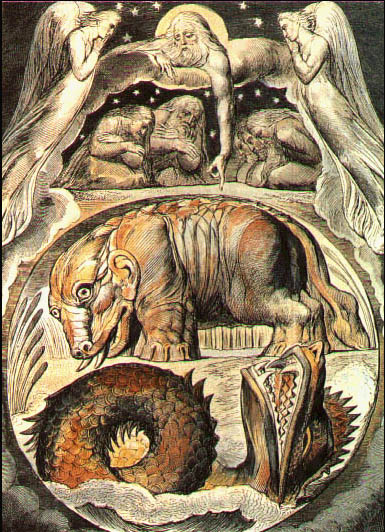
Second in the list of Demons in Behemoth. There's some controversy as to whether Behemoth is a demon or not, or even a mundane animal. The passage that calls this into question is "He [is] the chief of the ways of God:" Still, according to the Dictionnaire Infernal, Behemoth is classified along with the other demons.
From Wikipedia:
Behemoth is the name of a creature mentioned in the Book of Job, 40:15-24. In Hebrew it can be rendered as בהמות, Bəhēmôth, Behemot, B'hemot; in Arabic بهيموث (Bahīmūth) or بهموت (Bahamūt) .
The word is most likely a plural form of בהמה (bəhēmāh ("animal")). It may be an example of pluralis excellentiae, a Hebrew method of expressing greatness by pluralizing a noun; it thus indicates that Behemoth is the largest and most powerful animal.
Metaphorically, the name has come to be used for any extremely large or powerful entity.
The text from the Book of Job 40 (King James Version Bible) is as follows:
15 Behold now behemoth, which I made with thee; he eateth grass as an ox.
16 Lo now, his strength [is] in his loins, and his force [is] in the navel of his belly.
17 He moveth his tail like a cedar: the sinews of his thighs are wrapped together.
18 His bones [are as] strong pieces of brass; his bones [are] like bars of iron.
19 He [is] the chief of the ways of God: he that made him can make his sword to approach [unto him].
20 Surely the mountains bring him forth food, where all the beasts of the field play.
21 He lieth under the shady trees, in the covert of the reed, and fens.
22 The shady trees cover him [with] their shadow; the willows of the brook compass him about.
23 Behold, he drinketh up a river, [and] hasteth not: he trusteth that he can draw up Jordan into his mouth.
24 He taketh it with his eyes: [his] nose pierceth through snares.
(From Wikipedia - http://en.wikipedia.org/wiki/Behemoth)
Asmodeus Part 1 - Demonology Profile

This is the first installment of my new Demonology Profiles. Each profile will include several entries with cited material from Wikipedia and other sources. Starting it out is a well-known demon named Asmodeus...
Asmodai (Asmodeus, Asmodaeus, pronounced Ashmed or Ashmedai in Hebrew, also Chammadai, Sydonai) is a semi-Biblical demon mostly known thanks to the deuterocanonical Book of Tobit; he is also mentioned in some Talmudic legends and in demonology, as he is a leading figure in the construction efforts of the Temple of Solomon. Amongst critical scholars, legends about Asmodai are thought to derive from Zoroastrianism, and incorporated into Judaism (and hence Christianity) during the Persian Achaemenids' rule over the Jews.
Spelling variations
Æshma (Old Persian), Æshma-dæva, Ashmadia, Ashmedai (Hebrew), Asmodaios (Greek), Asmoday, Asmodée (French), Asmodee, Asmodei, Ashmodai, Asmodeios, Asmodeo (Spanish, from a Latin declination), Asmodeius, Asmodeus (Latin, as he is known in most translations of the Book of Tobit), Asmodi, Chammaday, Chashmodai, Sidonay, Sydonai. (Wikipedia - http://en.wikipedia.org/wiki/Asmodai)
Subscribe to:
Posts (Atom)